Learn how to rapidly deploy your first eOceans® project
Join a 30-minute onboarding session (+ 15 min Q&A).
The world can change fast —
understanding needs to keep up.
Are your stakeholders, funders, clients, or rightsholders still waiting for a report to tell them what has already happened—or what needs to happen next?
By the time a report is finished, the data may already be months old, priorities may have shifted, and important decisions may already have been made.
If you want to maintain trust, your evidence needs to keep pace with the people who depend on it.
eOceans® turns your workflow into one continuous system for collecting, connecting, analyzing, and communicating results—with results available whenever you need them.
That means:
→ Less time rebuilding
→ Lower project costs
→ Faster answers
→ More current, useful results
→ More capacity without adding people
→ More opportunities to demonstrate and grow your impact
Stop spending your expertise maintaining the workflow.
Let eOceans® do more of the work—so you can focus on what the evidence means and what to do next.
What changes with eOceans?
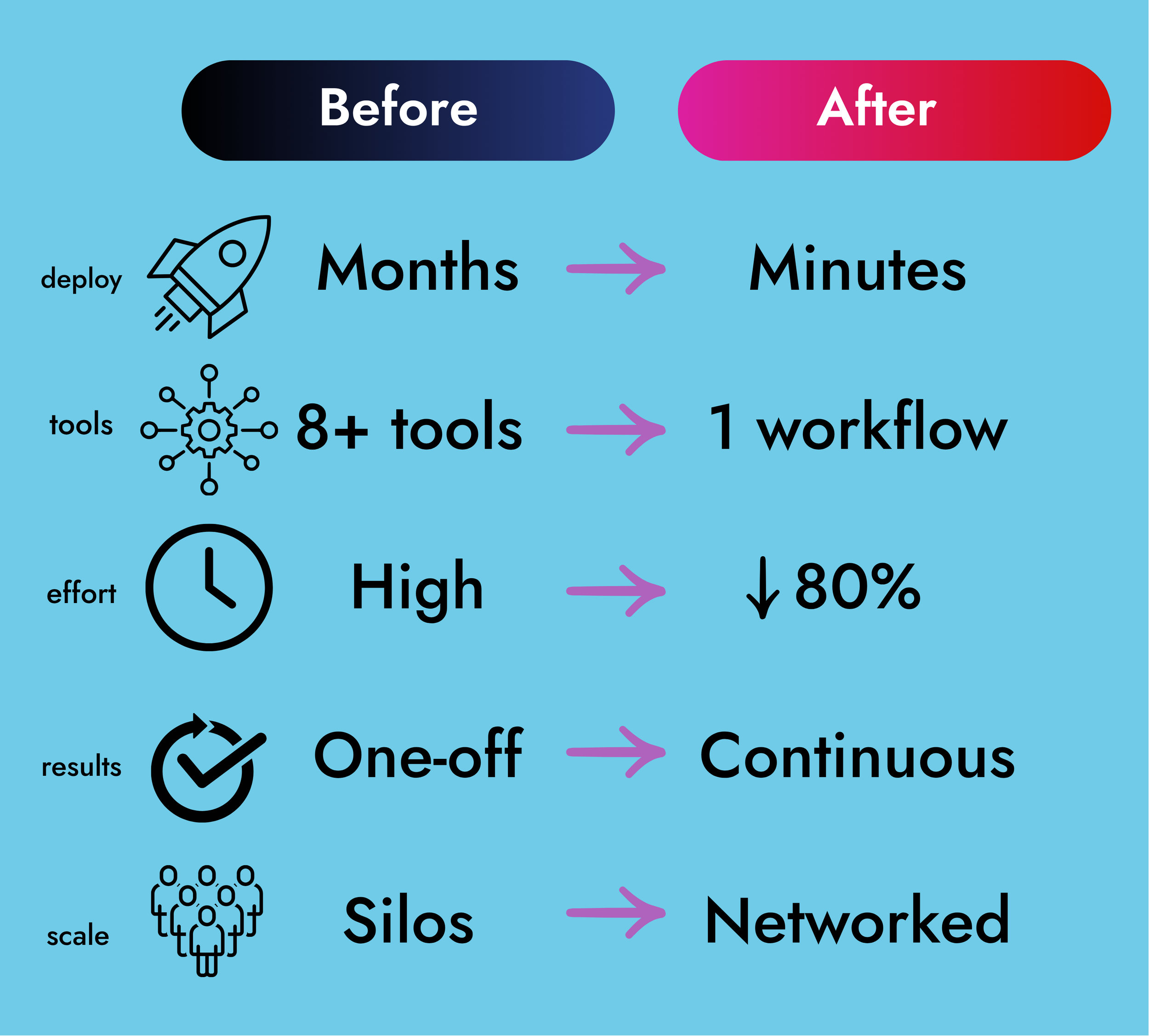
We’ve seen projects reduce time and effort by more than 80% compared with traditional workflows. The exact savings depend on the project—but the principle is the same:
Build the workflow once, in minutes.
Then keep using it as you collect more data, work with more people, and need new results.
And you don't have to do it alone.
The most valuable work increasingly happens when teams, companies, organizations, and networks work together.
With eOceans®, you can bring your existing data, collaborators, partners, and projects into a shared, continuously updating space — while keeping control over who can access and use your data and results.
Your first project can become the foundation for your next collaboration.

Why now?
Species move. Threats emerge. Ecosystems change. Communities adapt. Projects evolve. Policies are implemented. Investments are made.
The world doesn't wait for your reporting.
Move from static, one-off, outdated analysis and reporting to a continuously updating evidence base—where new observations, existing data, analysis, maps, and reports stay connected as your work evolves.
Not another dashboard, but a workflow that keeps working.
What can you use eOceans® for?
eOceans® is built for spatiotemporal observations — anything you need to observe, record, compare, track, and understand in the field — across space and time.
Your observations can be structured or unstructured, planned or opportunistic, scientific or community-generated, highly standardized or simple reports.
Use one approach or combine them all. The more ways you can capture relevant observations, the fewer gaps you have in your understanding.
Example uses include:
Wildlife and biodiversity
Human-wildlife interactions
Social and community values and access
Disease and wildlife health
Urban observations and risks
Fisheries and aquaculture
Protected areas and conservation
Environmental impact assessments and mitigation
Water quality, pollution, and environmental change
Infrastructure and development monitoring
Climate and ecosystem indicators
Research and long-term monitoring programs
The observations themselves could be as specific as:
Dead birds
Stray dogs
Discarded needles
Invasive species
Endangered species
Diseased animals
Poached animals
Whales, sharks, turtles, seals, elephants, coyotes, wolves, bears…
Roadkill
Human-wildlife interactions
Pollution events
Safety or security incidents
Unusual environmental events
Instead of relying on paper logsheets, spreadsheets, hotlines, emails, custom apps, or scattered data, observations can come through the eOceans® mobile app — or from your existing datasets, partners, laboratory results, cameras, sensors, environmental DNA, and other sources.
You decide what you need to know, what to collect, how to collect it, and where your data comes from.
eOceans® brings those different observations and data sources together so they can be connected, compared, analyzed, mapped, and continuously updated.
If you need to know what happened, where, when, and how it is changing, eOceans® can help you understand it.
Be the first to try it —
then bring in your collaborators.
Start with one project: bring an idea, research or consulting project, monitoring program, government initiative, question you're trying to answer, or dataset you've been struggling to use.
Let’s get it working.
Then, bring in your collaborators.
We'll show you how to create the structure for your project, connect your data, and start turning it into continuously updated results—so you can see what’s possible, share it with your partners, and decide where to take it next.
You don't have to wait for everyone else to figure this out first.
One hour today could save you and your partners thousands of hours tomorrow.

Bring your ideas.
Bring your projects.
Bring your network.
You don't need to have everything figured out before you attend. Think of this as a 30-minute window to see how eOceans® works, explore what's possible, and generate some ideas for your own work.
You could bring:
A question you're trying to answer
An existing project you want to improve
Old data you've struggled to use
A new monitoring program you're building
A network of collaborators you want to connect
Or just an idea you want to explore
We'll show you how to get started.
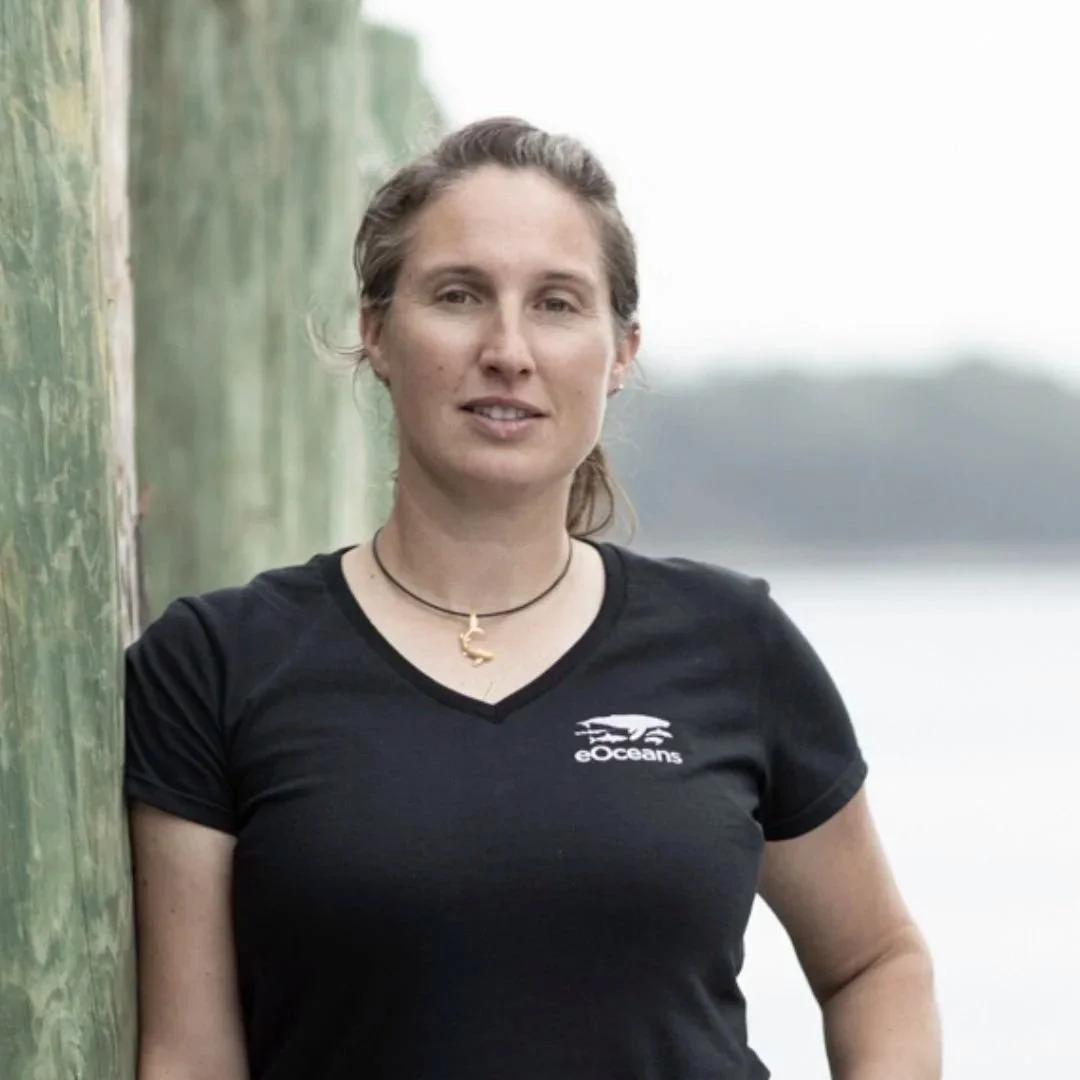
Why I built this.
I'm Dr. Chris Ward-Paige — Founder & CEO of eOceans®
For more than 20 years, I worked as a researcher and consultant across government, academia, industry, and conservation.
I kept rebuilding the same workflows.
I kept thinking: There has to be a better way!
So I built it.
eOceans® was created to help me get more from the data, expertise, capacity, and networks I already had—so I could spend more time on the work I was actually trying to accomplish.
Then I decided it should be available to everyone.
That’s why we created free sessions and free tiers—with transparent, accessible pricing, rather than enterprise-only software.
I’ll personally be leading these first global sessions, so this is a chance to meet, bring your questions and ideas, and see firsthand how I think about building better workflows from the problems I’ve experienced myself.
This is just the beginning.
This is our first global series.
We're inviting researchers, consultants, governments, conservation organizations, communities, developers, funders, and others who are ready to try a different way of working.
You don't need to compete with anyone.
You don't need to replace everything you're already doing.
Just start with one project.
Build it.
See how it works.
Then decide what you want to connect next.
The pioneers won't be the people with the most data.
They'll be the people who figure out how to turn their ideas into results.

Join us.
Build your first eOceans® project.
FREE · LIVE · GLOBAL
Bring your work.
Bring your questions.
Bring your collaborators.
Let's build it together.
Who is it for?
This is for people responsible for understanding change.
Researchers and academics
Spend less time rebuilding databases, cleaning data, writing code, and producing one-off outputs—and more time on the science, questions, and discoveries that matter.
Consultants
Deliver monitoring, assessment, and reporting projects faster without rebuilding technical infrastructure every time. Standardize workflows across projects while keeping each one configured to its own objectives and data.
Governments and institutions
Build consistent, defensible evidence across programs, teams, partners, and jurisdictions—and maintain an evidence base that doesn't disappear when a project or reporting cycle ends.
Funders and investors
Stop repeatedly funding the same data collection and reporting from scratch. Track progress across your portfolio, compare results over time, and use continuously updated evidence to help put future funding in the right place, at the right time.
Organizations working across networks
Bring partners, collaborators, communities, and other contributors into the same evidence base while maintaining control over access, data, and how results are shared.
Anyone with more data than capacity
Turn the data you already have into more results—without adding another layer of spreadsheets, code, geographic information systems, or custom infrastructure.
Anyone who needs to communicate on demand
When a funder, client, manager, community, board, regulator, or partner asks a question, answer from current evidence—not by starting another analysis from scratch.
Frequently asked questions.
Do I need to already use eOceans®?
No. This session is designed for both people who are new to eOceans® and existing users who want to learn new features, explore new ways to use the platform, or rethink how they could apply it to their work.
Do I need a dataset?
No. Bring a question, project, monitoring program, or idea. If you already have data, bring that too.
Can I bring my collaborators?
Yes—and we encourage it. eOceans® is designed to support work across teams, organizations, projects, and networks.
Can consultants use eOceans® for client projects?
Yes. eOceans® can support individual projects as well as workflows spanning multiple projects, teams, and partners.
Can government and institutional teams use it?
Yes. eOceans® supports structured monitoring, assessment, data governance, collaboration, analysis, and reporting across organizations and programs.
Is it only for ocean science?
No. eOceans® is location-, sector-, and objective-agnostic and supports environmental, ecological, social, and other spatiotemporal data workflows.
Is this a lecture?
No. We're building. You'll see how to start a project and begin turning your own questions and data into a continuously updating workflow.
Is it free?
Yes. The webinar is free, and you can start your first eOceans® project for free.
Your stakeholders, partners, and rights holders shouldn't be waiting for your next report.
Join us! Learn how to get started with your new workflow.