
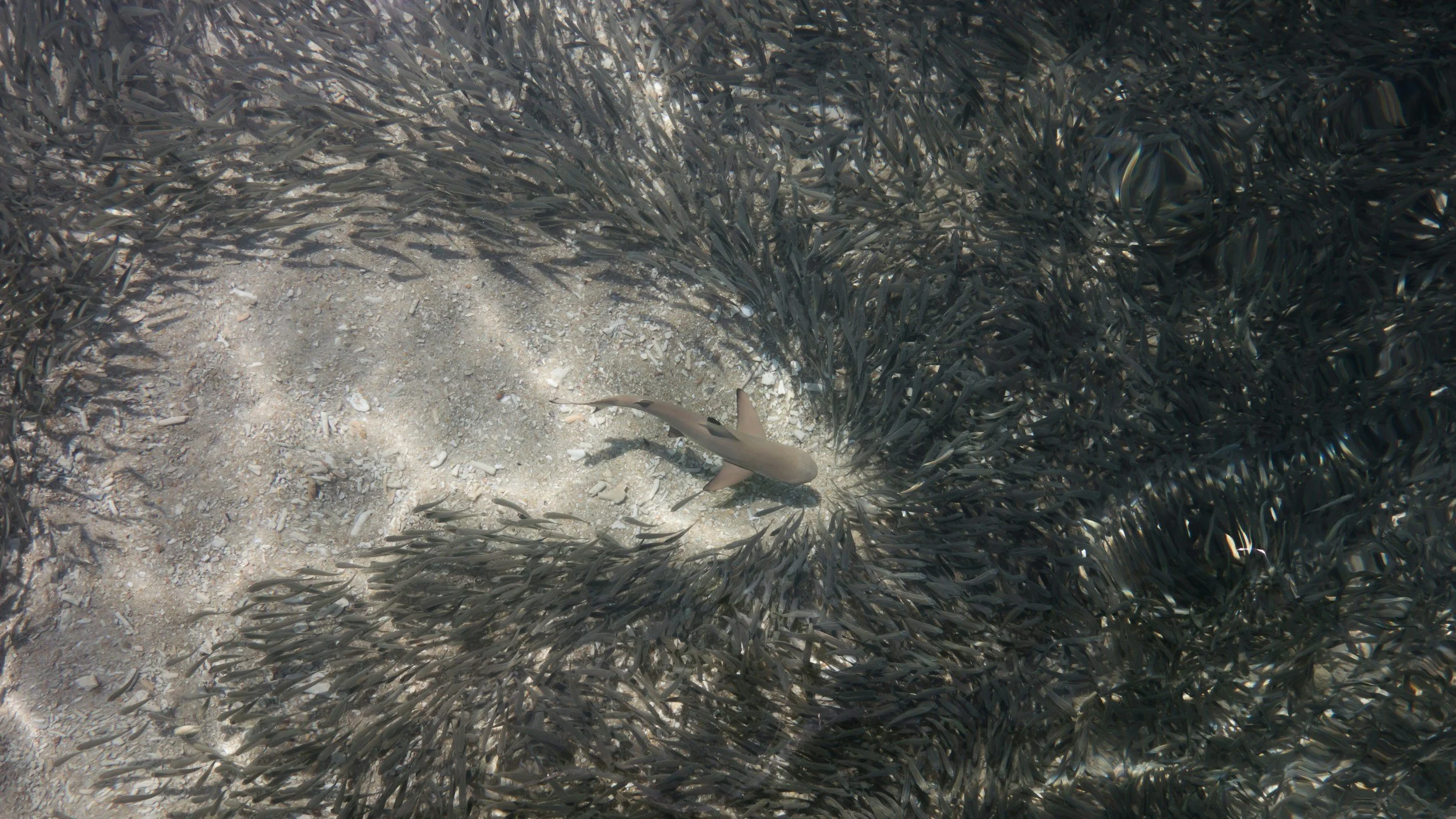
Can Citizen Science Track Shark and Ray Populations at Scale? Evidence from Thailand Suggests Yes

We don’t lack observers—we lack systems that can use what they see

Sharks and rays are among the most widely distributed yet least consistently monitored marine species.

Across much of the world, data on shark and ray abundance and movement are still sparse, expensive to collect, and often limited to short-term surveys in specific locations.

At the same time, thousands of trained divers, guides, and ocean users are in the water every day—observing marine life in real time across broad spatial and temporal scales. In many areas, they are specifically looking for sharks and rays.

The question is no longer whether these observations exist.

It is whether these observations can be structured and used in a way that supports science and management.

This study from Thailand explores that question directly.

What this study actually does

In Using eOceans diver data to describe contemporary patterns of marine animal populations: A case study of sharks in Thailand, researchers evaluated whether diver-reported observations could be used to describe meaningful patterns in shark populations over time.

Between 2012 and 2017, more than 9,500 dives across 153 sites were recorded by divers participating in a coordinated monitoring program led by eOceans.

Rather than relying on a single survey campaign, the study built a longitudinal dataset from routine diving activity—capturing when, where, and how often sharks were observed across a wide geographic area.

This approach created a continuous record of marine life encounters embedded within normal tourism operations, allowing researchers to examine both spatial and temporal patterns in shark occurrence.

What the study reveals

Across the study period, 12 shark species were recorded, with observations occurring across the majority of sites and in most months of the year.

Some species, including blacktip reef shark and leopard shark, were among the most frequently encountered and appeared consistently across both space and time.

Other species were observed less frequently, often appearing as individuals rather than in groups, reflecting the natural variability in distribution and detectability across species.

Importantly, the data revealed clear spatiotemporal patterns. Shark presence was not uniform—some sites consistently showed higher encounter rates, while others showed little to no occurrence. Seasonal variation was also evident, with certain species showing peaks in specific times of year that shifted across locations and years.

In addition to general distribution patterns, the dataset captured rare but important ecological signals, including occasional observations of mating behaviour and nursery areas for select species.

Taken together, these results provide a broad, real-world picture of shark presence in coastal Thailand that would be difficult to generate using traditional short-term survey methods alone.

Why this matters for real-world decisions

This work demonstrates that structured diver observations can contribute meaningfully to marine science—not as a replacement for traditional surveys, but as a complementary, scalable source of ecological information.

For managers, this means that spatial patterns of species presence can be tracked more continuously, rather than relying solely on periodic scientific expeditions.

For conservation planning, it provides a way to identify areas of repeated ecological importance, including potential hotspots, seasonal aggregations, and under-documented habitats.

For tourism and coastal industries, it reinforces the role of marine ecosystems not only as ecological systems, but also as observed, lived environments where human activity and biodiversity intersect.

And for science more broadly, it expands the set of tools available for understanding species that are otherwise difficult to monitor consistently at scale.

The gap no one talks about

Marine monitoring is often constrained not by lack of observation, but by lack of integration.

Traditional scientific surveys are rigorous but limited in frequency and spatial coverage. At the same time, large volumes of observational data from divers and ocean users are often underutilized because they are not collected within standardized analytical frameworks.

This creates a gap between what is observed and what can be analyzed.

The Thailand case shows that when structured appropriately, citizen-generated data can help bridge this gap—providing continuous, geographically broad insights into species distribution and presence.

The key is not replacing scientific methods, but connecting them more effectively with existing observational capacity.

What changes now

This study points toward a more integrated model of marine monitoring—one that combines scientific design with distributed observation.

Instead of relying exclusively on episodic surveys, it becomes possible to build continuous datasets from routine ocean activity, provided that data are collected consistently and interpreted within a robust analytical framework.

Platforms like eOceans are designed to support this integration—linking diver observations, spatial data, and analytical tools into a single system that can track changes over time.

The shift is not about replacing science with citizen observation.

It is about expanding the scale and continuity of what can be observed, without losing analytical rigor.

Frequently asked questions

Can citizen science really track shark populations? Yes—when data are collected consistently and across large spatial and temporal scales, they can reveal meaningful patterns in species distribution and occurrence.

What did this study show in Thailand? That diver-collected data across thousands of dives can be used to identify spatial and seasonal patterns in shark presence across multiple species.

Is this data scientifically reliable? When structured properly and analyzed carefully, it can complement traditional scientific surveys and provide valuable ecological insights.

What is the main limitation of citizen science data? It depends on consistency, effort tracking, and proper interpretation within a robust analytical framework.

How is this different from traditional surveys? Traditional surveys are more controlled but often limited in scale; citizen-generated data are broader in scale but require careful standardization.

Final thought

This study does not suggest that citizen science replaces traditional monitoring.

It shows that when structured well, everyday observations can extend the reach of science—making it possible to see patterns in marine ecosystems that would otherwise remain invisible at scale.
Read the full study

Published in Ocean & Coastal Management:
Using eOceans diver data to describe contemporary patterns of marine animal populations: A case study of sharks in Thailand
By Christine A. Ward-Paige, Annabel Westell, and Brendon Sing

Previous
Previous

How Many Sharks Are Killed Each Year? ~100 Million Annually, Reflecting the Scale of Global Fisheries Pressure on Sharks and Ocean Systems

Next
Next

Do Fishery Closures Work? Evidence from Canada Suggests Not Always