
What’s Causing the Loss of Manta Ray Tourism? Evidence Points to Widespread Fishing Pressure and Weak Protection in Key Regions
Tourism value is high, but populations are under pressure
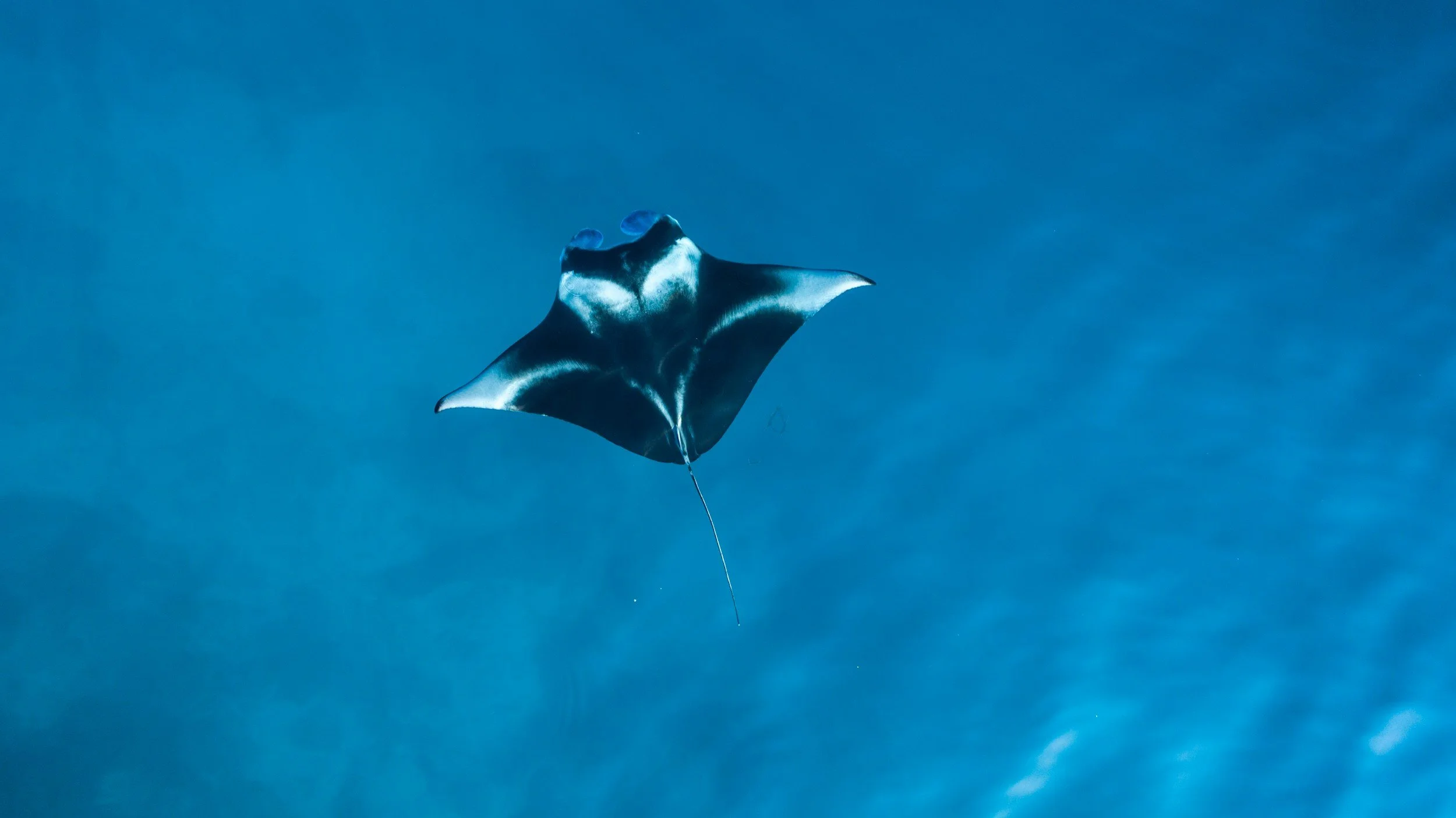
Manta rays are among the most valuable wildlife species in the ocean for marine tourism. In a small number of locations, they generate significant economic value, supporting local economies and livelihoods.
Yet in many of the same regions, populations are declining.
This raised the question: If manta rays generate substantial tourism revenue, why are they disappearing from many of the places that depend on them?
Illegal, unreported, unregulated (IUU) fishing.
What this study actually does
In “Global Population Trends and Human Use Patterns of Manta and Mobula Rays” (PLOS ONE), we synthesized over 600,000 diver observations across 90 regions of the world, combining two large-scale citizen science datasets to examine global distribution patterns, human use, and reported trends in manta and mobula rays.
The goal was to understand where manta rays are persisting, where they are declining, and how human activities—including fisheries and tourism—intersect across their global range.
Rather than relying on isolated case studies, this work integrates observations across broad spatial scales to identify consistent global patterns in occurrence and change.
What the study shows
Across regions, a consistent picture emerges: Manta and mobula rays are widely distributed but rarely abundant, and they tend to concentrate in a small number of predictable aggregation sites.
However, across nearly half of surveyed regions, divers reported declines in sightings over time. At the same time, areas of high tourism value often overlap with areas of fishing pressure and trade activity.
This combination is important. It suggests that for many populations, the same locations that support tourism value are also embedded within broader systems of unsustainable exploitation.
Tourism value does not necessarily imply protection
In many regions, manta rays are actively sought for ecotourism, often centred around feeding or cleaning aggregation sites. These sites can generate substantial economic activity, but the presence of tourism does not always align with formal protection or reduced fishing pressure.
In fact, only a subset of regions with tourism activity also reported regulatory protection measures that explicitly limit fishing or trade.
This separation between tourism value and management protection is a key feature of the global status of manta rays.
Fishing pressure and trade remain widespread
Across surveyed regions, observations and reported accounts indicate that manta and mobula rays are caught in multiple fisheries and appear in local markets in several parts of the world — especially in areas that are in close proximity to where they have high tourism value.
This spatial overlap is important because it highlights a recurring pattern: High-value aggregation sites for tourism are not safe from targeted fishing pressure.
Even where tourism is established, fishing and trade pressures still influence population declines.
Why this matters for manta ray populations
Manta rays have relatively slow life histories and low population growth rates, which means they are sensitive to sustained levels of removal. At the same time, their tendency to aggregate in predictable locations makes them both economically valuable for tourism and vulnerable to targeted or incidental catch. This combination creates a system where local gains from tourism can coexist with broader-scale declines driven by fishing pressure elsewhere in the range. As a result, population outcomes depend not only on local protection, but also on regional and international management and enforcement.
The key insight: value and decline can occur simultaneously
This study shows that manta ray tourism value and population decline are not mutually exclusive. In some regions, tourism is strong but sightings are still decreasing.
These patterns suggest that population status is shaped by multiple interacting pressures, including:
targeted fishing and bycatch
international trade networks
uneven protection frameworks and
variability in enforcement across jurisdictions
Understanding these dynamics requires integrating ecological observations with human use patterns at scale.
Why this matters for conservation and management
Manta ray populations span multiple jurisdictions, fisheries, and economic systems.
This means that no single policy or local management action is sufficient on its own.
Effective conservation depends on:
coordinated international protection mechanisms
better tracking of fishing and trade flows
improved monitoring of aggregation sites and
integration of ecological and human-use data streams