
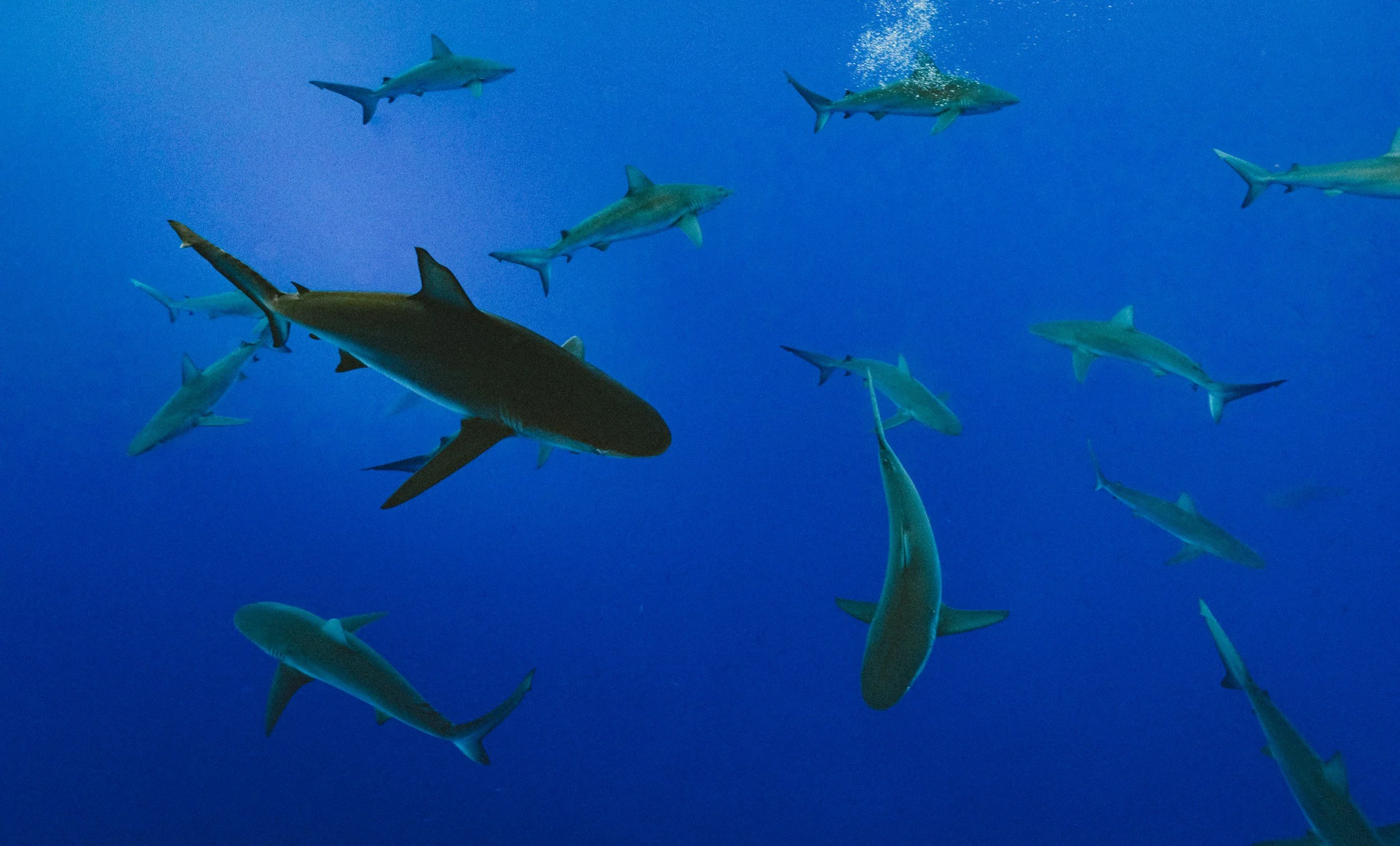
How to build a shark monitoring program?
Shark monitoring can represent a substantial investment in fieldwork, staff time, equipment, technology, permits, data management, and scientific expertise. When it is designed well, that investment can produce evidence that supports conservation, fisheries management, protected areas, environmental assessments, research, tourism, restoration, and decisions about how shark populations and habitats are changing.
It can also create a long-term record that becomes more valuable as observations accumulate. A monitoring program can establish a baseline, detect changes in distribution or abundance, identify important habitats, document threats, evaluate management actions, and provide evidence for future decisions.
But there is no single best way to monitor sharks.
Sharks vary enormously in size, behaviour, distribution, detectability, habitat use, and movement. Monitoring may involve divers, fisheries, cameras, acoustic receivers, satellite tags, BRUVs, genetic methods, aerial surveys, citizen observations, or combinations of approaches. Each method has different costs, logistical requirements, biases, data-processing demands, permitting requirements, and ethical considerations.
A well-designed program balances the questions you need to answer with what is ecologically appropriate and practically possible. The right approach depends on the distribution and behaviour of the shark populations, the scale and duration of the program, available budget and team capacity, available technologies, the ability to process and analyze the resulting data, permitting requirements, and ethical considerations.
A sophisticated technology is not necessarily a better monitoring method if the team cannot deploy it properly, manage the resulting data, or analyze the information it produces. A lower-cost approach may produce more useful long-term evidence if it can be applied consistently over time.
Start with the questions you need to answer, then design the monitoring around the sharks, the resources available, and the evidence you need to produce.
1. Define what you need to know
Start by identifying the questions the monitoring program needs to answer.
Are you trying to determine which species use an area? Understand abundance or population trends? Identify important habitats? Monitor a nursery or aggregation site? Understand movement and residency? Evaluate a protected area? Measure recovery? Document fisheries interactions? Assess the effects of tourism or another human activity?
The questions should drive the monitoring design.
A program intended to document species presence may require very different methods from one intended to estimate abundance, understand movement, or detect population change.
Do not design the monitoring around the method you already have. Design it around the evidence you need.
2. Understand the sharks you are monitoring
The biology and ecology of the target sharks should shape the program.
Consider:
species and life stages
population structure
distribution
habitat use
movement and migration
seasonal patterns
depth
behaviour
aggregation patterns
detectability
rarity
whether individuals can be identified
A method that works well for a resident reef-associated shark may be poorly suited to a highly migratory pelagic species.
Understanding the population comes before deciding how to measure it.
3. Define the spatial and temporal scale
Decide where and when monitoring needs to occur.
A local study might focus on a reef, bay, nursery, aggregation site, protected area, or fishing ground. A population-level question may require monitoring across much larger geographic areas.
Consider seasonality, migration, breeding, recruitment, environmental cycles, and the expected rate of change.
The spatial and temporal design needs to match the ecological process you are trying to understand.
4. Work within the resources available
Monitoring design has to reflect what the project can realistically sustain.
Consider:
budget
staff size and expertise
field time
vessels
equipment
access to sites
laboratory capacity
data-management capacity
statistical expertise
technology costs
long-term funding
A monitoring method that produces excellent data but cannot be maintained for more than one season may be less useful than a less intensive approach that can continue for years.
Design for the program you can actually sustain.
5. Choose technology that you can use well
Technology can greatly expand what is possible in shark monitoring.
Depending on the questions, options may include:
BRUVs
underwater cameras
acoustic telemetry
satellite telemetry
photo-identification
tagging
environmental DNA
aerial surveys
acoustic monitoring
fisheries monitoring
diver observations
But collecting data is only one part of using a technology.
Consider the capacity required to deploy it, maintain it, store the resulting data, process it, validate it, analyze it, and interpret it.
Thousands of hours of video are not automatically more valuable than a well-designed visual survey if there is no capacity to process the footage.
Choose technology based on the evidence it can produce and the capacity available to turn that data into knowledge.
6. Consider permits and ethics from the beginning
Shark monitoring can involve capture, handling, tagging, bait, chum, boats, fishing gear, underwater interactions, acoustic equipment, satellite tags, or other interventions.
Understand the permits and approvals required before designing the field program.
Consider animal welfare, disturbance, behavioural changes, provisioning effects, capture stress, mortality risk, habitat impacts, and the potential consequences of the monitoring itself.
Ethical considerations should be part of the design rather than something addressed after the methodology has already been chosen.
The best monitoring program is one that produces useful evidence without creating unnecessary impacts on the animals or ecosystems being studied.
7. Choose methods that match the question
Once the biological, practical, technological, regulatory, and ethical constraints are understood, choose the methods.
Different approaches answer different questions.
Visual surveys can provide direct observations. BRUVs can extend observation into areas or conditions where divers are not practical. Photo-identification can provide information about individual sharks. Telemetry can reveal movement and residency. Fisheries data can provide information about catches and interactions. eDNA can provide evidence of species presence.
Methods can also be combined.
The important consideration is what each method can and cannot tell you.
A shark detected by a BRUV is not equivalent to a shark observed by a diver, and neither necessarily represents abundance on its own.
8. Standardize effort
If the goal is to understand change, record the effort associated with each observation or survey.
Depending on the method, this could include:
dive duration
transect length
camera deployment time
BRUV deployment duration
number of sets
fishing effort
number of observers
distance travelled
number of receivers
receiver deployment time
number of tagged animals
Without effort, it becomes difficult to distinguish a change in shark observations from a change in how much effort was made to detect them.
More observations can mean more sharks. They can also mean more monitoring effort.
9. Record the conditions that affect detection
Sharks are not equally detectable under all conditions.
Visibility, depth, water temperature, sea state, current, habitat, time of day, weather, equipment, observer experience, bait or attractant use, and shark behaviour can all influence what is detected.
Record the conditions that could affect the observations.
This information can become critical when comparing sites, seasons, years, or monitoring methods.
10. Make identification defensible
Shark identification can be difficult, particularly for closely related species, juveniles, damaged animals, unusual individuals, or poor-quality observations.
Establish identification protocols and define how uncertainty will be recorded.
Where possible, retain supporting evidence such as photographs, video, diagnostic features, genetic samples, or expert verification.
Do not force an uncertain observation into a species category simply because the database requires one.
Uncertainty should be recorded, not hidden.
11. Build quality control into the workflow
Quality control should happen throughout the monitoring program.
Check for:
duplicate observations
impossible locations
inconsistent species names
invalid dates
unusual counts
incompatible measurements
identification conflicts
missing effort information
observations outside expected ranges
problems introduced during data processing
Quality control should flag observations for review rather than automatically removing unusual records.
A rare species or unexpected location may be exactly what the monitoring program is intended to detect.
12. Keep observations connected to their context
A shark observation becomes much more useful when its context stays with it.
Connect observations to:
location
date and time
method
effort
environmental conditions
observer
identification
individual identification where relevant
photographs or other evidence
associated human activities
This makes observations collected by different people, methods, and projects easier to interpret and combine.
13. Plan the analysis before collecting the data
Think about how the information will eventually be analyzed.
If you want to detect population trends, estimate abundance, compare sites, understand habitat use, identify movement patterns, or evaluate management effectiveness, the monitoring design needs to support those analyses.
Depending on the question, the analysis may need to account for:
detection probability
effort
seasonality
environmental conditions
site differences
observer effects
gear or technology differences
repeated observations
individual re-sightings
spatial and temporal variation
The analysis should be possible because of the monitoring design, not despite it.
14. Connect different sources of shark information
Shark knowledge often exists across many groups.
Researchers may have tagging and survey data. Fisheries may have catch and effort records. Dive operators may have repeated sightings. Conservation organizations may collect observations from communities and the public. Governments may hold monitoring, assessment, and regulatory data.
These sources do not have to be collected in exactly the same way to be useful.
But their methods, effort, provenance, limitations, and uncertainty need to remain clear.
Connecting information does not mean treating every observation as equivalent.
15. Make the data useful beyond the original project
A shark observation can become much more valuable when it remains available for future questions.
The same monitoring record might eventually support:
a new environmental assessment
a protected area review
a fisheries assessment
a conservation evaluation
a research publication
a funding proposal
an investigation of population change
an analysis of climate-related shifts
Do not let years of observations become a spreadsheet that is only opened when the next report is due.
The monitoring program should create an evidence base, not just a deliverable.
16. Build for long-term learning
Shark populations and the environments they use are changing.
New observations should be able to build on the existing record. Methods may evolve. New technologies may become available. New questions will emerge.
Keep the protocols, metadata, quality-control decisions, analyses, and outputs connected as the program changes.
When staff leave, the knowledge should remain.
When funding changes, the existing evidence should not disappear.
When a new question emerges, the accumulated record should provide a starting point.
Build a shark monitoring program that keeps learning
A strong shark monitoring program connects the question, shark ecology, sampling design, resources, technology, permits, ethics, field methods, effort, validation, analysis, and reporting from the beginning.
eOceans is designed to connect that workflow, so observations from divers, fisheries, BRUVs, telemetry, researchers, tourism operators, and other sources can become part of a continuously growing evidence base.
Building your own shark monitoring program? Get started in eOceans and build the workflow yourself.
—> Get powered by eOceans®.