Are There Still Sharks on Caribbean Reefs?
Human Pressure Has Left Many Reefs Functionally Empty
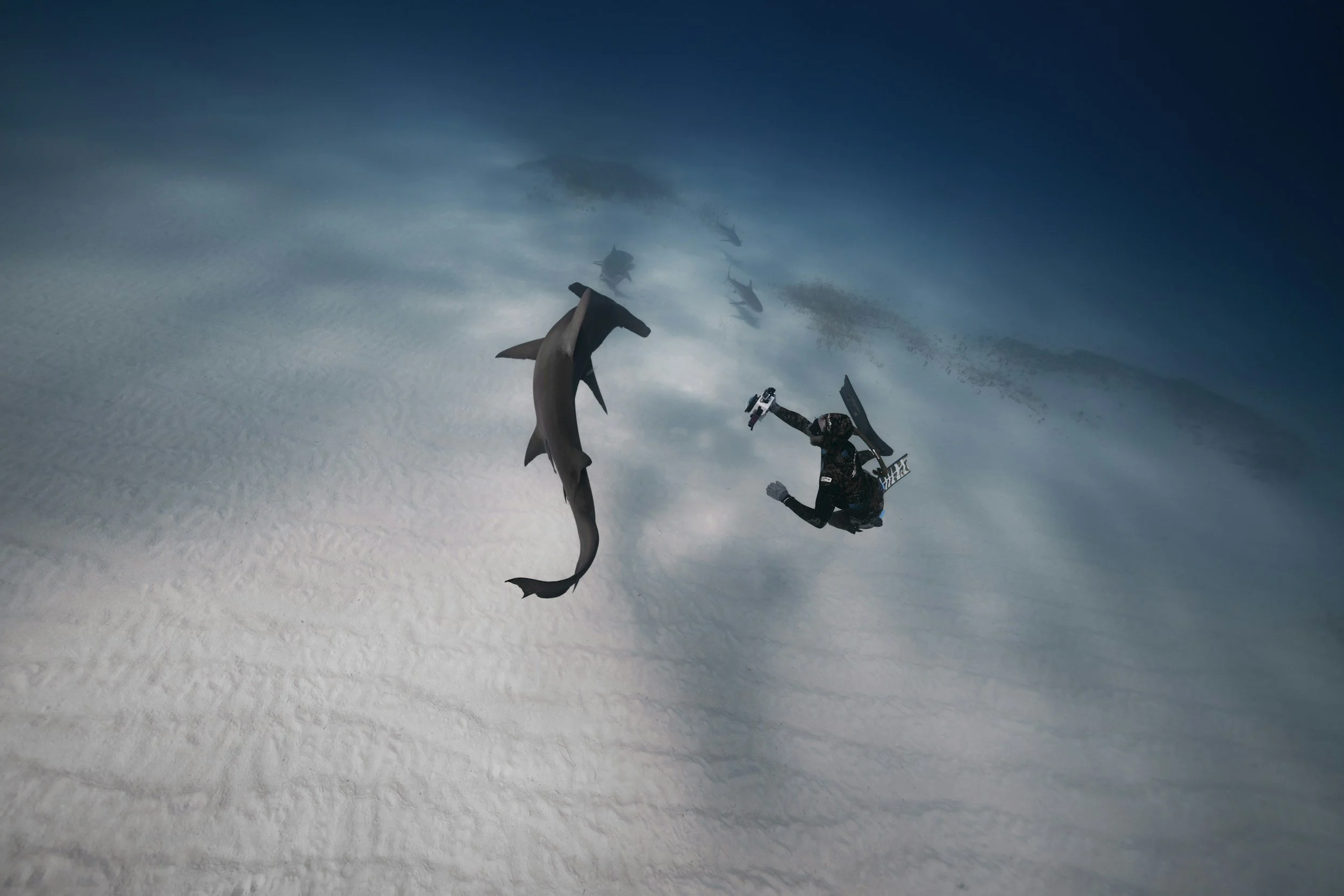
For centuries, sharks were a defining feature of Caribbean reefs—described as common, expected, and ecologically dominant. Today, that expectation has quietly shifted.
This study asks a stark question: Where are the sharks now?
By examining reef systems across the greater Caribbean, it reveals not just localized declines—but a broad, region-wide pattern of absence.
What this study actually does
In “Large-Scale Absence of Sharks on Reefs in the Greater-Caribbean: A Footprint of Human Pressures”, we analyzed over 76,000 underwater surveys conducted by trained divers between 1993 and 2008.
These observations were aggregated across space to map:
where sharks are still found
how often they are encountered
how these patterns relate to human presence
We then compared shark sighting frequency with human population density and used population models to test whether fishing pressure alone could explain the patterns observed.
This combination of large-scale observational data and modelling allows for a rare, system-wide view of shark presence across an entire region.
What the study shows
The result is clear and deeply concerning: Sharks are largely absent from Caribbean reefs.
With the exception of species like the nurse shark, most reef-associated sharks are now rarely encountered across much of the region.
Instead, a strong pattern emerges: Sharks are primarily found in places with very low human population density—or in areas with strong protection and enforcement. This is not a patchy or isolated effect. It is a consistent regional signal linking human presence to ecological absence.
Several key insights emerge:
Shark sightings decline sharply as human population increases. Even moderate coastal development corresponds with reduced encounters.
Fishing pressure alone can explain much of the loss. Population models show that even low levels of exploitation can drive shark populations to a small fraction of their original size within decades.
Other stressors compound the effect. Habitat degradation, pollution, and coastal development further suppress populations already vulnerable to fishing.
Some species persist where others do not. Nurse sharks remain relatively common, likely because they have historically been less targeted and often survive capture.
Why this matters for reef ecosystems
Sharks are not just another group of species—they are top predators that help structure entire ecosystems.
Their absence signals more than biodiversity loss. It reflects a fundamental shift in how these reefs function.
When sharks disappear:
trophic interactions change
prey populations can increase or behave differently
ecosystem balance can be altered in ways that are difficult to reverse
In this sense, many Caribbean reefs are not just degraded—they are missing key ecological roles.
What the data reveal about human impact
One of the most powerful aspects of this study is how clearly human pressure maps onto ecological outcomes. Reefs near dense human populations are far less likely to have sharks.
But the inverse is also true: Sharks still exist where pressure is low—or where management is strong.
In places like parts of the Bahamas, Florida, and the U.S. Virgin Islands, sharks persist despite human presence, largely due to long-term protections and effective enforcement.
This provides an important insight: The absence of sharks is not inevitable—it is driven.
The key limitation: historical baselines
A critical challenge in interpreting these results is understanding what has already been lost. Historical records suggest sharks were once widespread and abundant across the Caribbean. What we see today is not a natural distribution—it is the result of centuries of cumulative pressure. Without that historical context, current low densities risk being misinterpreted as normal.
What changes now
This study shifts the framing from decline to absence.
Not “fewer sharks” but “sharks missing from most reefs”
It also clarifies what is required to reverse that trend:
reducing fishing mortality to very low levels
protecting critical habitats
addressing cumulative coastal impacts
enforcing regulations consistently over time